Interview
Veronika Zhuk
VOKA 3D Anatomy & Pathology, United States
As CEO of VOKA 3D Anatomy & Pathology, Veronika Zhuk is advancing the future of healthcare communication through 3D medical visualization, creating technologies that make complex science more accessible to professionals, educators, and patients alike.
1 Please provide us a brief bio of yourself and your health industry background.
I’m Veronika Zhuk, CEO of VOKA 3D Anatomy & Pathology. For more than nine years, I’ve led the company’s strategic direction and overseen the development of our 3D medical visualization and healthcare technology projects, with a focus on making complex science more accessible through visual storytelling.
2 What motivated you to pursue this particular health initiative, and what impact has it had on individuals or communities?
Sooner or later, everyone becomes a patient. Yet understanding complex medical information without a scientific background can be challenging. That's what motivates us to make healthcare knowledge more accessible through 3D animation. We also recognize the growing importance of visual learning in medical education. By transforming complex concepts into engaging visual experiences, we aim to support not only patients and the general public, but also students, educators, and healthcare professionals in their learning and everyday practice.
3 Tell us more about your business/company, your job profile, and the specific responsibilities you undertake.
VOKA 3D Anatomy & Pathology is a MedTech company specializing in 3D medical visualization, healthcare technology, and scientific communication. We develop medical animations, interactive models, AR/VR solutions, and digital educational tools for healthcare professionals, pharmaceutical companies, educators, and patients. As CEO, I lead the company's strategic direction, business development, and the creative and production processes behind our projects.
4 Can you share a specific story or testimonial that exemplifies the positive impact your project has had on an individual or community?
We've received very positive feedback from the focus group that reviewed the animation during its development. One comment we heard repeatedly was that the animation felt both scientifically accurate and visually engaging, which was exactly the balance we set out to achieve.
5 What inspired you to create this health-related creative project, and what message or impact were you aiming to convey?
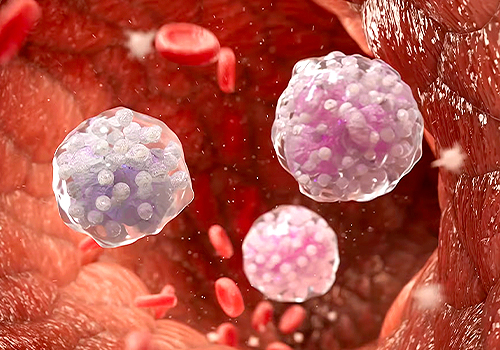
Some of the most important processes in the human body happen every day, yet most people rarely think about them. The immune system works continuously, but few understand how immune cells develop or just how complex that process really is. With this project, we wanted to make that invisible process easier to understand. Our goal was to present granulocytopoiesis in a way that feels clear, engaging, and accessible rather than purely technical or academic.
6 What unique artistic or creative elements did you utilize to communicate the health message or story?
We also wanted the animation to feel dynamic and immersive. To achieve that, our team combined detailed cellular modeling with cinematic lighting, depth of field, and carefully choreographed camera movements, giving viewers the feeling of exploring the bone marrow environment firsthand.
7 How does your creative project contribute to raising awareness, promoting behaviour change, or improving health outcomes?
We believe people understand complex concepts more easily when they can see them. For students and healthcare professionals, medical animation supports learning by making challenging topics easier to understand and remember. For patients and the general public, it helps bridge the gap between medical science and everyday understanding, empowering people to make more informed decisions about their health.
8 What unique and compelling elements did you incorporate into your advertising materials to capture attention and deliver the health message effectively?
Our animations also serve as effective communication and marketing tools. Because healthcare and life science topics can be complex, we use motion, cinematic visuals, and immersive storytelling to make the content more engaging, memorable, and easier to understand.
9 Congratulations! As a winner of the TITAN Health Awards, what does it mean to you, your company or team to receive this award distinction?
Thank you! This recognition means a great deal to our entire team. Every project is the result of close collaboration between medical experts, artists, animators, and developers, so this award recognizes the collective effort behind everything we create. It also reflects the growing importance of medical and scientific visualization in healthcare communication and reinforces our commitment to making complex science more accessible through visual storytelling.
10 Can you explain a bit about the winning work you entered into the TITAN Health Awards, and why you chose to enter this project?
We chose Inside Immune System: Granulocytopoiesis Explained in 3D because it demonstrates our team's ability to transform complex biological processes into engaging visual experiences. The project reflects our approach to combining scientific accuracy with cinematic storytelling, showing that medical education can be both visually immersive and highly accessible.
11 What was the biggest challenge with this project?
The main challenge was creating a microscopic environment that felt both scientifically accurate and visually cinematic. We carefully balanced scientific references with artistic interpretation to build an immersive experience while remaining true to human physiology.
12 How has winning an Award developed your practice/career?
For our company, this recognition strengthens our international visibility and creates new opportunities to collaborate with healthcare, pharmaceutical, and educational organizations. On a personal level, it's incredibly rewarding to see years of work at the intersection of healthcare, technology, and visual communication recognized by an international platform.
13 What are your top three (3) things you think is unique about the health industry?
Healthcare is, above all, a human-centered industry. Every innovation has the potential to improve people's lives, making accuracy, responsibility, and trust essential at every stage, from research to communication. It is also a field that evolves rapidly, with new scientific discoveries emerging every day. Transforming that complexity into clear, accessible information remains an ongoing challenge. At the same time, effective communication is what allows medical advances to make a real impact, making visualization an increasingly valuable tool in healthcare.
14 What makes your country unique in the health industry?
The United States is home to one of the world's most innovative healthcare ecosystems, where healthcare, technology, and digital innovation work closely together. It provides an environment where new ideas in medical communication and health technology can grow, evolve, and reach global audiences.
15 Where do you see the evolution of the health industry going over the next 5-10 years?
We already see healthcare becoming increasingly digital and patient-centered. As this transformation continues, visualization will play an even greater role in education, training, and communication, from medical education to public health awareness. Technologies such as 3D animation, AR/VR, and interactive platforms will continue to bridge the gap between scientific complexity and everyday understanding, making healthcare information more accessible than ever.
16 What resources would you recommend to someone who wants to improve their skills in the health industry?
It really depends on what someone wants to learn. For evidence-based medical knowledge, peer-reviewed journals and platforms like PubMed remain the gold standard for accessing reliable, up-to-date clinical information. For a more visual approach to anatomy, our VOKA 3D Anatomy & Pathology app offers an interactive way to explore anatomy and pathology, making complex concepts easier to understand. We also provide VOKA Wiki, where articles are created by our in-house medical experts, along with quizzes that help reinforce learning and test knowledge.
17 Who has inspired you in your life and why?
I'm deeply inspired by the people working in healthcare, especially the doctors and researchers who dedicate their lives to advancing medicine and improving patient care. Their commitment to continuous learning, innovation, and helping others motivates our team to create tools that support their work.
18 What is your key to success? Any parting words of wisdom?
I believe curiosity is one of the greatest drivers of growth because it encourages continuous learning, exploration, and innovation. When that curiosity is paired with a genuine sense of purpose, especially in healthcare, it has the power to create work that is both meaningful and lasting.
19 Do you have anything else you would like to add to the interview?
We'd like to sincerely thank everyone for this recognition and for shining a spotlight on our work in healthcare communication. It's an honor to see our efforts acknowledged, and it motivates us to continue advancing the way complex medical science is communicated. We're already working on new ideas and look forward to returning with even more innovative projects that continue to raise the standard for medical visualization.