Interview
Tingyu Su
United States
Tingyu Su is a Bay Area–based designer and the founding designer at Youlify, an AI-powered medical billing platform. Shaped by early research experience at Carnegie Mellon University, she focuses on helping physicians and hospitals get paid faster and more transparently.
1 Please provide us a brief bio of yourself and your health industry background.
My name is Tingyu Su, and I am a designer based in the Bay Area. I am currently building Youlify which is AI medical billing solution. My first step into the health industry came through research at Carnegie Mellon University, where I contributed to a project on ICU and critical care. That experience gave me a deep appreciation for the complexity and urgency of healthcare systems. Driven by both my interest in healthcare and my passion for building products from 0 to 1, I joined Youlify as the founding designer. Youlify addresses a critical pain point for physicians and hospitals: how to get paid fairly, faster, and more transparently.
2 What motivated you to pursue this particular health initiative, and what impact has it had on individuals or communities?
Many practices and hospitals struggle with complex insurance processes and delayed payments. I wanted to help restore financial freedom so doctors could focus on their patients instead of paperwork. Practices using Youlify have recovered more revenue and gained real financial clarity. When practices are financially healthy, they can stay open, hire more staff, and provide better care for their communities.
3 Tell us more about your business/company, your job profile, and the specific responsibilities you undertake.
Youlify is an AI company that helps doctors and hospitals manage their billing. Instead of relying on old-fashioned manual processes, we built a solution that streamlines the entire process and make it faster and more transparent. I am the founding designer at Youlify. I work on both the products and brand marketing. On the product side, I design how doctors and hospitals interact with our platform so it feels simple and easy to use. On the brand side, I make sure our website, campaigns, and events clearly show our impact and vision. I also work closely with our leadership team to connect the business goals with the user experience.
4 Can you share a specific story or testimonial that exemplifies the positive impact your project has had on an individual or community?
One customer told us that Youlify recovered more in one month than his previous biller did in six. That single change helped him stay independent and continue serving patients in his area. Another practice shared that with Youlify, they finally understood where their revenue was going and how to improve their workflow. These stories remind me why this work matters. When providers are supported, patients benefit too.
5 What inspired you to create this health-related creative project, and what message or impact were you aiming to convey?
This project started from a real problem our CEO faced while leading a hospital department. He saw how billing issues were hurting both doctors and patients. We wanted to solve that problem with advanced technology that actually works in real settings. It has been inspiring to see how our solution is helping practices recover revenue, save time, and focus again on patient care.
6 What unique artistic or creative elements did you utilize to communicate the health message or story?
I approached the project like weaving. Each data point, user flow, and visual detail works together to form a clear picture. The design uses calm colors, simple data visuals, and human-centered language to make complex financial information easy to understand. The brand voice reflects confidence and empathy, and every interaction aims to make users feel supported and in control.
7 How does your creative project contribute to raising awareness, promoting behaviour change, or improving health outcomes?
The financial aspect is vital for the entire U.S. health industry. Many doctors overlook how much billing impacts their ability to serve patients because it was never a lecture within their almost a decade of training. By streamlining the revenue process, providers can spend less time on paperwork and more time with patients.
8 What unique and compelling elements did you incorporate into your advertising materials to capture attention and deliver the health message effectively?
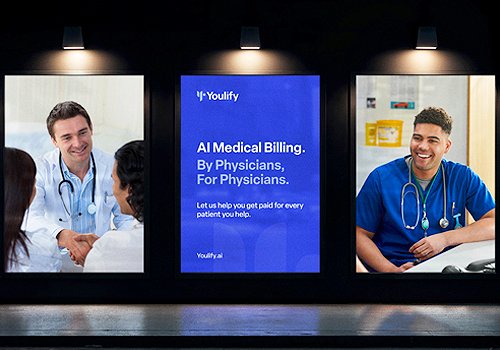
Youlify AI is built by physicians for physicians. Our founding team has experienced the pain of billing and reimbursement firsthand, so we understand how much it affects both doctors and patients. We also bring deep technical experience in artificial intelligence. Our CTO holds a PhD in AI, mentored by one of the fathers of modern AI. This blend of clinical and technical expertise allows us to create real solutions that work in the real world.
9 Congratulations! As a winner of the TITAN Health Awards, what does it mean to you, your company or team to receive this award distinction?
This recognition means a lot to our team and to me personally as the solo designer. It affirms that our visual language and storytelling are communicating our message clearly and meaningfully.
10 Can you explain a bit about the winning work you entered into the TITAN Health Awards, and why you chose to enter this project?
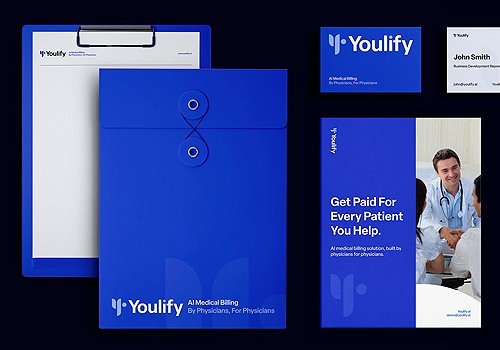
I entered the awards with Youlify’s branding and marketing work. Our visual language and communication strategy help doctors see that financial clarity is possible. Entering this work was a way to celebrate how storytelling can move a mission forward.
11 What was the biggest challenge with this project?
The biggest challenge designing the brand identity and marketing material was bridging the technical complexity of medical coding and billing with a human-first, visual design approach. We needed to translate a system full of codes, payer rules, and compliance layers into something that feels intuitive and supportive for users. Making technical workflows understandable without losing accuracy required many iterations. Finding that balance between precision and empathy was hard but rewarding.
12 How has winning an Award developed your practice/career?
I hope winning an award like this gives our work visibility and credibility. It has helped me connect with more healthcare innovators who care about both technology and design.
13 What makes your country unique in the health industry?
The mix of entrepreneurship, incredible innovation, complexity, strong regulation, and a high need for efficiency makes the U.S. a unique environment for healthcare innovation.
14 Where do you see the evolution of the health industry going over the next 5-10 years?
Artificial intelligence will help not only in behind-the-scenes work like billing and operations but also in clinical decision-making. Health data will become more connected across systems.
15 What resources would you recommend to someone who wants to improve their skills in the health industry?
I recommend starting with understanding healthcare systems and regulations, and talking to real healthcare professionals.
16 What is your key to success? Any parting words of wisdom?
Keep learning, listen deeply, and design with purpose!